
Varta Gel Battery vs AGM: The Key Differences You Need to Know
Both technologies are VRLA batteries. They are sealed and maintenance-free. But the differences between them determine which one belongs in your car, boat, solar system, or industrial equipment.
How the Electrolyte Is Held
In an AGM (Absorbent Glass Mat) battery, the electrolyte is absorbed into a compressed borosilicate fiberglass mat sandwiched between the lead plates. The acid is bound in the mat but not chemically changed. In a Gel battery, the electrolyte is chemically transformed into a solid gel using fumed silica. It physically cannot flow.
This matters because AGM’s tight plate-to-mat compression significantly reduces internal resistance. Internal resistance in a quality AGM battery is typically between 3 and 8 milliohms for a 100Ah unit, compared to 8 to 15 milliohms for an equivalent Gel battery. Lower internal resistance means AGM batteries can deliver a much faster, higher burst of power.
Cold Cranking Performance (CCA)
This is AGM’s biggest advantage and Gel’s clearest weakness as a starter battery. AGM batteries can deliver high cold-cranking amperage (CCA) for short intervals. The Varta AGM range delivers up to 900 CCA in its top configurations. Gel batteries, due to higher internal resistance, cannot produce the same powerful burst of starting current.
Varta explicitly states that conventional Gel batteries are NOT designed as starter batteries for modern cars. Forcing a Gel battery into a starter application leads to accelerated plate corrosion and rapid capacity degradation, often within one to two seasons.
Deep Cycle Performance and Cycle Life
This is where Gel batteries shine. Deep cycling means repeatedly discharging a battery to 50% to 80% depth of discharge (DoD) and then recharging it. Gel batteries, with their low electrode wear rate and controlled acid migration, are engineered for sustained, repeated deep discharge cycles.
According to IEC 60896-21, the international standard for stationary lead-acid batteries, properly maintained Gel batteries in deep cycle applications can achieve 500 to 1200 cycles at 80% DoD. This compares to 300-500 cycles for standard flooded batteries under the same conditions. AGM batteries also have excellent cycle life, roughly 3 times that of a conventional flooded battery. But in pure deep-cycle applications, a Gel battery can be the superior long-term investment.
Temperature Sensitivity
AGM batteries perform well from -30°C to +60°C. Gel batteries have a narrower optimal operating range. Their gel electrolyte can experience partial dehydration and micro-crack formation at sustained temperatures above 50°C. For UAE applications, Gel batteries should not be exposed to direct sunlight for prolonged periods and should be charged with a temperature-compensated (TC) smart charger. Installing them in locations with some thermal protection is also important.
For outdoor solar installations in Sharjah or desert-edge properties near Al Ain, temperature management is critical.
Charging Requirements Compared
This is the most important technical difference for everyday users in the UAE.
Charging Parameter | AGM Battery | Gel Battery |
Float Voltage (12V) | 13.5 to 13.8V | 13.5 to 13.8V |
Absorption Voltage | 14.4 to 14.7V | 14.0 to 14.2V (strict) |
Equalisation Voltage | 15.0 to 15.5V | Never equalise |
Charger Tolerance | Moderate | Strict, overcharge damages gel |
Recommended Charger | Smart multi-stage charger | Smart charger, Gel mode required |
Overcharging a Gel battery above 14.4V causes the gel electrolyte to crack and pull away from the lead plates. This irreversible process is called gel desiccation or electrolyte dry-out. Once this happens, internal resistance increases sharply, and capacity drops permanently. This is the single most common cause of premature Gel battery failure in the UAE.
Cost and Availability
Gel batteries typically cost 20% to 40% more than AGM batteries of equivalent Ah capacity. This premium is justified when the application genuinely suits Gel technology. In starter applications, paying more for a Gel battery that is not designed for the job is simply money wasted. At Battery Zone UAE, we always recommend the right technology for your use case, not just the most expensive option.
If you have ever stood in front of a battery shelf trying to decide between a Varta Gel battery and an AGM, you are not alone. It is one of the most common questions we get at Battery Zone UAE. Both look nearly identical from the outside. Both are sealed and maintenance-free. Both carry the trusted Varta name. But underneath the casing, they are built for very different jobs.
The wrong choice can cost you hundreds of dirhams in premature failure, damaged equipment, or frustrating breakdowns, especially in the UAE’s demanding heat. This guide breaks down exactly how a Varta Gel battery works, how it genuinely differs from AGM technology, and the specific situations where Gel is actually the smarter pick for UAE drivers, boat owners, solar users, and fleet operators.
What Is a Varta Gel Battery? Understanding the Technology
A Varta Gel battery is a type of VRLA (Valve-Regulated Lead-Acid) battery. It is a sealed and maintenance-free battery. It also has an internal pressure-relief valve that controls gases produced during charging.
What makes it a Gel battery is the electrolyte design. In a normal flooded lead-acid battery, the electrolyte is liquid. In a Gel battery, the liquid electrolyte is changed into a thick jelly-like material.
This is done by adding fumed silica (silicon dioxide, SiO2) to the sulphuric acid (H2SO4) electrolyte. The result is an immobilized, paste-like gel that surrounds the lead plates. This process is called gelation. It changes the battery’s electrochemical behavior, especially during charging, discharging, and repeated cycling.
Research published in the Journal of Power Sources shows that silica-gelled electrolytes have lower ionic conductivity loss under thermal stress compared with absorbed electrolytes. This helps improve service life in cyclic applications.
The Internal Structure of a Varta Gel Battery
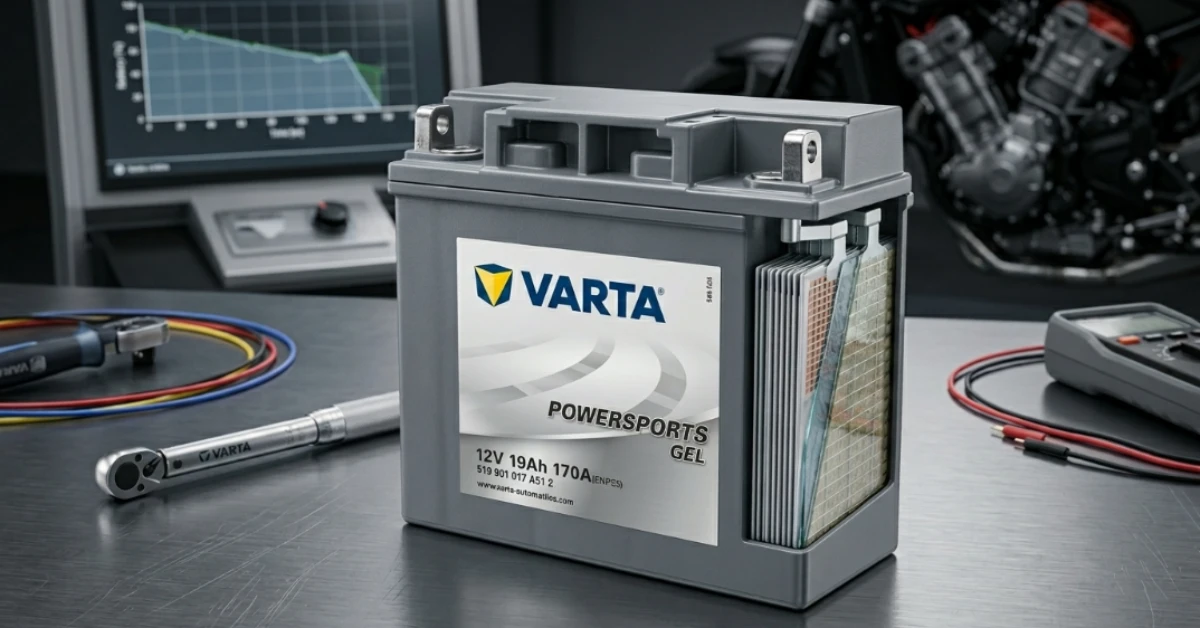
A Varta Gel battery is built around these core components. Lead plates, both positive and negative, are made from a lead-calcium-tin alloy to reduce gassing and self-discharge. The silica-gelled electrolyte is immobilized and cannot leak or spill in any orientation. A sealed polypropylene casing requires zero water top-ups.
A safety pressure-relief valve opens only in extreme overcharge events, typically at internal pressures above 50 to 150 mbar. The self-discharge rate is typically between 1% and 3% per month at 20 degrees Celsius, because the gel slows natural charge loss during storage.
Because the electrolyte is sealed, Gel batteries are inherently spill-proof, vibration-resistant, and position-flexible. You can mount them sideways or at unusual angles without risking acid damage. This is a practical advantage for marine vessels, motorcycles, and industrial equipment.
How Does a Varta Gel Battery Work?
A Varta Gel battery has positive and negative lead plates inside a sealed casing. Instead of a liquid acid electrolyte, it uses a silica-based gel electrolyte that remains fixed in place.
This gel allows charged particles called ions to move between the plates during discharge and charging. The main ions are hydrogen (H+) and sulfate (SO4²-) ions. This electrochemical ion exchange lets the battery store and release energy.
During Discharge
Stored chemical energy changes into electrical energy. The battery powers loads such as lights, motors, pumps, and electronic devices.
At the negative plate, the reaction is:
Pb + SO4²- → PbSO4 + 2e-
At the positive plate, the reaction is:
PbO2 + SO4²- + 4H+ + 2e- → PbSO4 + 2H2O
Power flows in a steady way. This makes Gel batteries ideal for deep-cycle applications, where long, stable output is more important than short-term peak power.
During Charging
The charger restores the battery’s electrochemical balance. Reverse reactions convert lead sulfate (PbSO4) back into lead (Pb) and lead dioxide (PbO2).
Because the electrolyte is in gel form, acid stratification is greatly reduced. Acid stratification is a common flooded-battery problem in which heavier acid sinks to the bottom.
Reducing stratification lowers plate sulphation, improves internal stability, and extends service life during repeated deep-discharge use
At-a-Glance Comparison: Varta Gel Battery vs AGM
Feature | Varta Gel Battery | Varta AGM Battery |
Electrolyte Type | Fumed silica gel (solid, SiO2-based) | Absorbed in borosilicate fibreglass mat |
Cold Cranking Power | Low, not for engine starting | High, up to 900 CCA; ideal for start-stop |
Deep Cycle Performance | Excellent, engineered for cyclic use | Very Good |
Cycle Life at 80% DoD | 500 to 1200 cycles (IEC 60896-21) | 300 to 600 cycles |
Temperature Range | Best below 45°C; caution in extreme heat | Tolerant from -30°C to +60°C |
Charging Sensitivity | High; max 14.2V absorption voltage | Moderate; tolerates up to 14.7V |
Internal Resistance (100Ah) | 8 to 15 milliohms | 3 to 8 milliohms |
Self-Discharge Rate | 1% to 3% per month at 20°C | 2% to 4% per month at 20°C |
Vibration Resistance | Excellent (immobilised electrolyte) | Excellent |
Maintenance Required | None | None |
Ideal Application | Solar, marine, UPS, mobility aids | Cars, start-stop, high-load inverters |
Relative Cost vs Flooded | 20% to 40% premium | 10% to 25% premium |
When Should You Choose a Varta Gel Battery? UAE Applications
Solar Energy Storage in UAE Homes and Villas
Solar systems in Dubai, Abu Dhabi, and Sharjah are growing fast. The UAE National Energy Strategy 2050 targets 44% clean energy in the national energy mix. Residential solar use has also more than doubled since 2020.
For off-grid and hybrid solar systems, the battery bank is the main power storage unit. This is a classic deep-cycle application, where Gel batteries perform very well.
If a solar battery bank is discharged each night to 50% Depth of Discharge (DoD) and recharged daily, a well-maintained Gel battery bank can deliver 700 to 1000 cycles before dropping to 80% retained capacity. This equals around 2 to 3 years of daily residential cycling.
Common UAE uses include:
- Home solar systems in Dubai and Abu Dhabi
- Commercial solar backup in Sharjah factories and warehouses
- Agricultural solar water pumping in Al Ain and Liwa
Marine and Boat Applications in Dubai Marina and Ras Al Khaimah
Boat batteries are subjected to constant vibration, often in the 10-100Hz range at sea. They also face salt-air humidity above 80% RH and repeated deep discharge from onboard electronics.
Gel batteries work well here because the immobilized electrolyte cannot move, spill, or slosh with waves or vessel tilt angle.
They are ideal for powering:
- Marine electronics
- Navigation systems
- Lighting systems
- Pumps and onboard accessories
Low self-discharge below 2% per month helps boats parked for weeks in Dubai Marina or Ras Al Khaimah start again without a dead battery.
Zero off-gassing in normal operation also reduces hydrogen accumulation in enclosed bilge spaces. This is a real advantage in fire and explosion safety.
UPS Systems and Backup Power
UPS (Uninterruptible Power Supply) systems in homes, offices, and server rooms usually stay on a float charge. They discharge during power cuts and recharge once power returns.
This charging pattern aligns well with the Gel battery design.
The IEEE 1188 standard for maintenance and replacement of VRLA batteries in stationary systems identifies Gel-VRLA technology as suitable for float service in:
- Telecommunications systems
- UPS systems
- Backup power rooms
For businesses on Sheikh Zayed Road or Tecom, Gel batteries in UPS systems can provide 5 to 8 years of service life under controlled indoor temperature.
Mobility Aids and Medical Equipment
Electric wheelchairs, mobility scooters, and medical devices require reliable, stable battery power.
Gel batteries are suitable because they provide:
- Zero gas emission for indoor use
- Reliable steady-state power for motors
- Long cycle life
- Lower replacement frequency
- Better total cost of ownership
This is important where batteries operate close to users indoors.
Golf Carts, Forklifts, and Industrial Electric Vehicles
Slow-speed electric vehicles such as golf carts, forklifts, airport ground vehicles, and warehouse equipment often charge and discharge many times each day.
A typical golf cart battery bank may discharge to 60% to 70% DoD in one round, sometimes multiple times daily at clubs in Dubai Sports City or Yas Island.
Gel batteries are a strong option here because they offer:
- Good deep-cycle performance
- Low maintenance
- No gas emission
- Safe indoor charging use
- Reliable repeated cycling performance
When You Should NOT Choose a Gel Battery?
Being honest matters more than making a sale. Here are the situations where Gel is the wrong choice.
- Standard car starting: The cold-cranking requirements will rapidly stress and damage a Gel battery.
- Vehicles with start-stop systems: These require AGM specifically, as confirmed by Varta’s BEM (Battery Energy Management) specifications and the EN 50342-6 standard for start-stop batteries.
- High-current fast charging: Charging at C-rates above 0.2C (20% of Ah capacity per hour) irreversibly damages the gel structure.
- High-amperage inverter applications: Sustained loads above 0.5C are better served by AGM.
- When you only have a standard charger: Without a Gel-mode smart charger with the correct voltage profile, do not buy Gel.
Does a Varta Gel Battery Last Longer?
Yes, a Varta Gel battery can last longer when used in the correct deep-cycle application. Research by Ruetschi (2004), published in the Journal of Power Sources, found that gel-type VRLA batteries show lower positive plate corrosion rates than AGM batteries under the same cycling conditions. Lower corrosion is a key reason for longer service life in deep-cycle use.
A Varta Gel battery typically provides 5 to 8 years of service life in solar systems or UPS applications when used with a compatible charger. In the same type of use, a conventional flooded battery often lasts 2 to 3 years.
This longer lifespan, plus lower maintenance cost, often makes the higher purchase price more cost-effective over a 10-year period.
However, wrong charging settings, overcharging, undercharging, or poor maintenance can reduce battery life to under 18 months, even with a premium Gel battery.
Biggest Charging Mistakes That Damage Gel Batteries
- Most Gel battery failures in the UAE are caused by improper charging rather than manufacturing faults. Here are the most common errors to avoid.
- Using a standard automotive charger set to AGM or WET mode will push absorption voltage to 14.4V or higher, exceeding the safe Gel limit of 14.2V and causing gel desiccation.
- Repeated fast charging at currents above 0.2C fractures the silica gel matrix over time.
- Deep draining the battery below 10.5V under load causes irreversible sulphation that cannot be recovered even with a desulphation charger.
- Leaving a discharged Gel battery for 2 to 3 weeks without recharging can cause deep sulphation, permanently reducing capacity.
- Mixing old and new batteries in a single battery bank creates a charge imbalance, with the stronger batteries overcharging the weaker ones.
Failing to account for temperature compensation means your charger applies a fixed voltage regardless of ambient temperature. In the UAE’s summer heat of 40°C to 45°C, the charge voltage should be reduced by approximately 3 mV per cell per degree above 25°C, or 18 mV per 12V battery per degree above 25°C.
How to Maintain a Varta Gel Battery?
Although a Varta Gel battery is maintenance-free in the sense that it requires no electrolyte top-ups, regular care still significantly improves performance and longevity.
- Recharge the battery soon after use, ideally within 24 hours of any significant discharge.
- Keep battery terminals clean and free of oxidation. Torque terminal connections to 3 to 4 Nm for M5 terminals to prevent connection resistance build-up.
- Store the battery fully charged. A Gel battery stored at 50% state of charge will self-discharge to damaging levels within 2 to 3 months at UAE temperatures.
- Avoid complete discharge cycles wherever possible. Keep depth of discharge below 80% to maximize cycle life.
- Perform periodic voltage checks. A fully charged 12V Gel battery should read between 12.8V and 12.9V at open circuit voltage (OCV) after resting for 1 hour.
- Keep the battery in a cool, dry location during storage.
Cost vs Value: Is Gel Worth It?
A Gel battery often costs 20% to 40% more upfront than a standard flooded battery of equivalent Ah rating, and 10% to 25% more than a comparable AGM battery. However, over a 5- to 8-year service life in a suitable deep-cycle application, the total cost of ownership is often lower.
Consider a residential solar backup system needing a 200Ah 12V battery bank. A flooded battery at that capacity may need replacement every 2 to 3 years at a cost of AED 800 to 1,200 per replacement cycle.
A Varta Gel battery of the same capacity, when correctly installed and charged, may last 6 to 8 years before reaching 80% retained capacity. This is the end-of-life threshold defined by IEEE 1188. The result is lower total replacement cost over a 10-year period. For marine systems, caravans, solar storage, and backup power systems in the UAE, a Varta Gel battery is often a smart long-term investment.
Varta's Gel Battery Range Available at Battery Zone UAE
Varta offers Gel batteries primarily through their Powersports Gel range, designed for motorcycles, touring bikes, and leisure vehicles. These are maintenance-free, factory-activated gel-filled batteries ideal for bikes with ABS, heated grips, ride-by-wire systems, and advanced electronics that require a stable supply voltage with low electrical noise.
All battery acid is safely suspended in a gel, eliminating the risk of spills under any conditions. The batteries are fully sealed with no maintenance required. They are designed for seasonal use and sporadic recharging, making them ideal for UAE weekend riders who park their bikes for weeks between rides. The immobilized electrolyte handles vibration from desert trails and long highway runs equally well.
At Battery Zone UAE, we stock the full Varta range, including Powersports Gel, AGM, and EFB options. Our team can identify the correct Varta part number for your specific motorcycle or leisure vehicle by model, year, and specification.
Why Battery Zone UAE Is Your Trusted Varta Partner?
At Battery Zone UAE, we do not just sell batteries. We match the right technology to your specific vehicle, application, and conditions. With the UAE’s unique combination of extreme summer heat regularly reaching 45°C to 48°C in parts of Abu Dhabi, varied applications from desert off-roading to marina-based vessels, and a rapidly growing solar energy market, the battery decision genuinely matters.
We provide the correct Varta battery model for your car, motorcycle, boat, or solar system. We stock the right smart charger to maximize your battery’s service life in UAE conditions. We ensure proper installation to maintain full warranty compliance. We also offer UAE-specific seasonal guidance from Ramadan storage periods to summer heat spikes.
Choosing the Right Charger for Your Varta Gel Battery in the UAE
The UAE climate means batteries are often stored in hot garages or on boats under direct sunlight during summer. Ambient temperatures regularly rise above 40°C in July and August. This increases the self-discharge rate by about 1.5 times for every 10°C rise above 25°C, based on the Arrhenius equation for electrochemical reaction rates.
For Gel batteries, a smart charger with a dedicated Gel mode is not optional. It is essential.
Look for these charger features:
- Multi-stage charging with bulk, absorption, and float phases instead of a basic trickle charger
- Temperature compensation that adjusts charge voltage according to ambient temperature
- Gel-specific voltage profile limiting absorption voltage to 14.0V to 14.2V
- Desulphation or reconditioning mode to recover a mildly over-discharged Gel battery using low-frequency pulse conditioning
Battery Zone UAE stocks smart chargers fully compatible with Varta Gel batteries, available in a 220V UAE-spec configuration. Ask our team for a matched charger recommendation when purchasing your battery.
Frequently Asked Questions
No. If your vehicle was fitted with an AGM battery, especially if it has a start-stop system, you must replace it with another AGM. The vehicle's Battery Management System (BMS), which is present in nearly all Euro 5 and Euro 6 vehicles sold in the UAE, is calibrated for AGM chemistry and charges the battery accordingly. Fitting a Gel battery will cause shortened life, possible system fault codes, and unreliable starting.
With proper charging and reasonable temperature management, a high-quality Gel battery in a suitable application, such as solar, marine, or UPS, can last 5 to 8 years. Lifespan drops sharply if overcharged above 14.2V, chronically undercharged below 12.6V at float, or used in a high-current starting application.
Generally yes. Most modern alternators regulate output between 13.8V and 14.4V, which is within acceptable limits for Gel batteries. However, if using a Gel battery as a secondary leisure battery in a vehicle, monitor the alternator output with a voltmeter. Some high-output alternators in diesel vehicles can briefly exceed 14.4V during bulk charging, which can risk gel desiccation over time.
Yes. Gel batteries produce no acid vapors and generate negligible hydrogen gas under normal operating and charging conditions. This is because of the oxygen recombination cycle (ORC), where internally generated oxygen recombines at the negative plate rather than venting. This makes them safe for enclosed spaces, including indoor server rooms, home offices, and medical settings.
They perform adequately but are more susceptible to long-term gel degradation under sustained extreme heat than AGM. For shaded, indoor, or thermally protected applications, Gel performs well year-round across the UAE. For exposed outdoor installations, consult Battery Zone UAE before choosing Gel over AGM.
Battery Zone UAE is your trusted source for the full Varta range, including Powersports Gel batteries. We serve customers across Dubai, Abu Dhabi, Sharjah, Ajman, Ras Al Khaimah, and the Northern Emirates, with delivery available.