
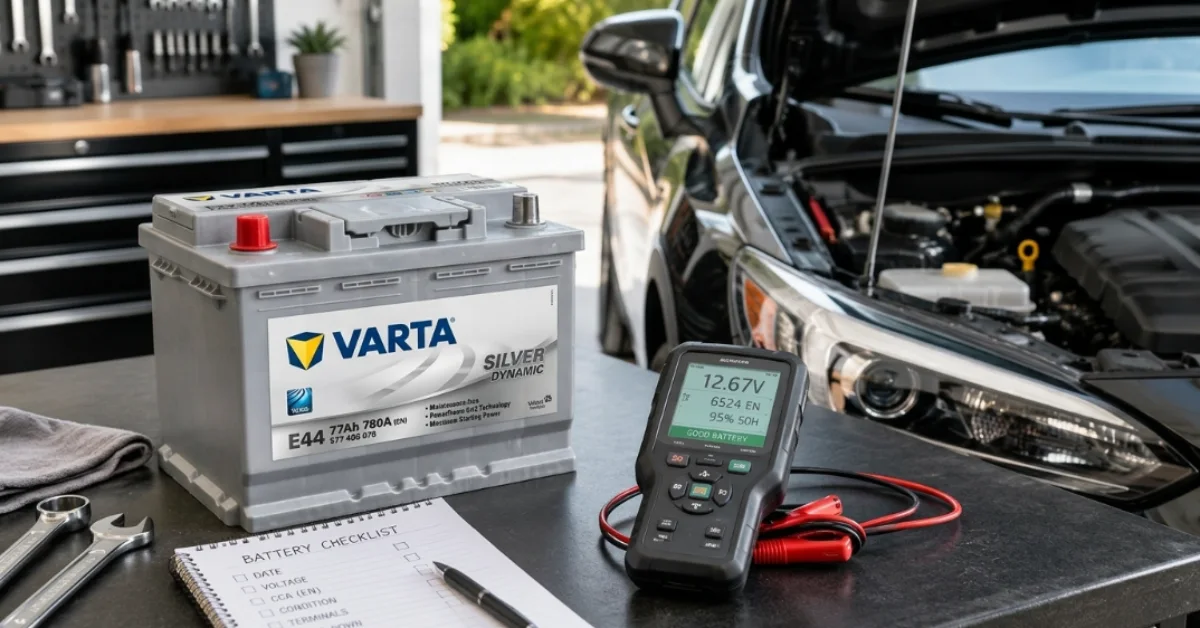
To choose the right Varta car battery, match the battery type, Ah rating, Cold Cranking Amps (CCA), and physical group size with your vehicle’s OEM specification. A correct match improves engine starting, charging balance, and battery life. A wrong battery can affect the Battery Management System (BMS), cause comfort feature faults, and reduce battery life to less than 12 months.
Battery Zone UAE provides genuine Varta batteries for sedans, SUVs, luxury cars, and daily-use vehicles across Dubai, Abu Dhabi, and Sharjah. This guide explains all the important specs, battery type differences, and fitment checks driver needs before buying.
6 Key Factors for Choosing the Right Varta Car Battery Model
1. Vehicle Make, Model, and Engine Size
Your vehicle’s make and engine displacement define the correct battery power class. Two cars from the same brand can require completely different batteries based on engine size and electrical architecture.
Common OEM fitment examples:
- Toyota Corolla (1.6L to 2.0L petrol) uses a 60Ah battery
- Nissan Patrol (V6/V8) uses a 70Ah to 95Ah battery
- BMW 5 Series uses an AGM battery in the 80Ah to 95Ah range
- Suzuki Swift (1.2L to 1.4L) uses a 45Ah to 55Ah battery
Match battery capacity precisely to OEM spec. Oversizing Ah overloads the alternator charging curve. Undersizing Ah pushes the battery into Partial State of Charge (PSoC) operation, accelerating sulfation on the negative plates and causing premature capacity loss.
2. Battery Capacity (Ah Rating)
Ah (Ampere-hour) measures how much energy a battery stores and sustains under continuous load. Modern vehicles carry heavy electrical loads, including climate control, lane-keep assist, rear-view cameras, and infotainment systems , all of which draw from the battery during engine-off phases.
Ah ranges by vehicle segment:
- 45Ah to 55Ah for compact hatchbacks like Hyundai i10, Kia Picanto, Suzuki Alto
- 60Ah to 75Ah for sedans like Honda Civic, Toyota Camry, Nissan Sentra
- 75Ah to 95Ah for SUVs like Toyota Prado, Mitsubishi Pajero, Ford Expedition
Operating a battery below its rated Ah in a vehicle with a high electrical load creates a chronic PSoC condition. In PSoC, the battery never reaches a fully charged state. Lead sulfate crystals accumulate on the negative plate surface, raising internal resistance. It causes the BMS to misread the state of charge. It also makes the battery appear healthier than it is while its capacity quietly drops.
3. Cold Cranking Amps (CCA)
CCA measures the discharge current a 12V battery delivers at 0°C for 30 seconds while maintaining a minimum of 7.5V, as defined under the EN 50342-1 test standard. A sufficient CCA value ensures the starter motor receives enough amperage for a clean ignition event.
Many drivers assume CCA only matters in cold climates. This is incorrect. Researchers tested 60 identical taxis running in the extreme heat. Every conventional SLI battery failed within 5 to 6 months. The comparison group fitted with AGM batteries remained operational throughout the test period without a single replacement.
Heat accelerates internal chemical reactions, increases electrolyte evaporation, and reduces the available CCA at engine start. A battery already operating at reduced CCA in summer heat has no reserve for the high-draw ignition moment.
CCA requirements by engine type:
- Petrol sedans (1.2L to 2.0L): 450 to 600 CCA (Toyota Corolla needs 450 to 550 CCA)
- Diesel SUVs and pickups: 700 to 850 CCA (Toyota Land Cruiser, Ford Ranger, Mitsubishi Triton)
- V8-powered SUVs: 700 to 850 CCA with AGM technology recommended (Nissan Patrol, GMC Yukon)
Never select a CCA value below the vehicle’s OEM minimum. Higher CCA than the OEM minimum is always a safe and beneficial choice.
4. Battery Technology Compatibility (AGM, EFB, SMF)
Modern vehicles use a dedicated Battery Management System (BMS) to control alternator charge voltage, monitor State of Charge (SoC), and regulate energy recovery during braking.
The BMS is factory-calibrated for a specific battery chemistry. Fitting the wrong chemistry causes 3 specific failure modes: reduced start-stop system efficiency, comfort function dropouts, and shortened battery service life.
- AGM required for BMW, Audi, Mercedes-Benz, and Porsche models with extended start-stop and regenerative braking systems
- EFB required for Toyota Corolla, Nissan Altima, Volkswagen Golf, and Kia Sportage models with basic start-stop systems
- SMF is suitable for pre-2012 vehicles like the Toyota Yaris, Suzuki Swift, and Hyundai Accent without start-stop systems
Upgrading from EFB to AGM is always safe and recommended for high-demand driving. Downgrading from AGM to EFB is technically prohibited; the BMS applies AGM charge curves (absorption voltage 14.4V to 14.8V) to an EFB or SMF battery. It exceeds their safe charge acceptance rate, leading to overheating, gassing, and accelerated plate corrosion.
5. Physical Group Size and Terminal Layout
Group size defines whether the battery seats correctly in the vehicle tray. A mismatch of even 5mm in length or width causes loose fitting, vibration stress on the internal plate connections, and unstable current transfer at the terminals.
6 fitment checks to complete before purchase:
- Verify tray length, width, and height against the OEM battery dimensions.
- Confirm terminal polarity; the positive terminal position (left or right) varies by make and model.
- Match terminal type; top-post and side-post terminals are not interchangeable.
- Check the battery height to clear the bonnet insulation panel.
- Confirm that the hold-down clamp is in the correct position to secure the battery base without pressing on the casing.
- Align the vent tube outlet to ensure proper gas release in enclosed battery compartments.
6. Manufacture Date and Stock Freshness
All lead-acid batteries self-discharge during storage. A battery stored in a warehouse at 40°C loses capacity significantly faster than one stored in a controlled environment. Batteries more than 6 months from their manufacture date have already experienced measurable sulfation and capacity loss before installation.
Always check the manufacturer’s date stamped on the battery label. Buy stock under 3 months old wherever possible. Fresh stock delivers full-rated Ah capacity, full CCA, and the longest possible service life from day one.
The 3 Varta Battery Technologies Explained
AGM: Best for Luxury and Advanced Start-Stop Vehicles
AGM (Absorbent Glass Mat) is the highest-performance lead-acid battery technology available. The electrolyte is immobilized within fiberglass mat separators rather than floating as a free liquid. This construction makes the battery fully sealed, leak-proof, and capable of much faster charge acceptance than flooded designs.
Best-fit vehicles include the BMW 5 Series, Mercedes-Benz E-Class, Audi Q7, and Porsche Cayenne.
The 5 technical advantages of Varta AGM:
- Delivers 3x the charge cycle life of a conventional SMF battery under EN 50342-6 test standards
- Accepts charge current at 25% to 35% of nominal capacity, enabling rapid recharge during short urban drives
- Supports full start-stop operation with regenerative braking energy recovery
- Maintains stable voltage supply to electronics, including ECUs and comfort systems, during engine-off phases
- Resists vibration stress through tightly compressed glass mat construction
One rule applies without exception: always replace AGM with AGM. Fitting EFB or SMF in an AGM-spec car causes BMS calibration errors and an immediate reduction in start-stop system performance.
EFB: Best for Modern Daily Drivers with Start-Stop
EFB (Enhanced Flooded Battery) is an advanced flooded lead-acid battery. It uses a polyfleece (Polyvlies) scrim layer bonded to the positive plate surface. This layer stabilizes the active material, prevents plate shedding during deep cycling, and significantly improves charge acceptance compared to a standard SMF battery.
Best-fit vehicles include the Toyota Corolla, Nissan Altima, Volkswagen Golf, and Kia Sportage.
The 5 technical advantages of Varta EFB:
- Delivers 2x the charge cycle life of a conventional SMF battery under repeated PSoC conditions
- Handles frequent micro-cycling from start-stop operation without accelerated sulfation
- Improves thermal stability in hot engine compartments; a key advantage for engine bay temperatures
- Provides low internal resistance for consistent cold-start current delivery
- Costs significantly less than AGM while outperforming any standard SMF battery in cycle durability
Replace EFB with EFB at a minimum. Upgrading to AGM is safe and beneficial when the vehicle carries heavy electrical accessories or when EFB failures recur under urban driving conditions.
SMF: Best for Older and Basic Vehicles
SMF (Sealed Maintenance-Free) is a conventional flooded-lead-acid battery. It suits vehicles with simple electrical systems and no start-stop or energy recovery function. It provides reliable cranking power for standard petrol engines at an accessible price point.
Best-fit vehicles include Toyota Yaris, Suzuki Swift, Mitsubishi Lancer, and Hyundai Accent pre-2015 models without start-stop systems.
The 4 practical advantages of Varta SMF:
- Delivers dependable cold-start current for standard petrol engines within the 45Ah to 75Ah range
- Requires no electrolyte top-up throughout its service life
- Fits standard tray dimensions across most older vehicle segments
- Provides the lowest cost entry into Varta battery quality
Do not install SMF in any start-stop-equipped vehicle. The BMS will apply AGM or EFB charge curves to the SMF battery. The resulting overvoltage causes excessive gassing, accelerated water loss, and premature plate failure; typically within 6 to 9 months in the extreme heat.
AGM vs EFB vs SMF: Side-by-Side Comparison
Battery Type | Best-Fit Vehicles | Cycle Life vs. Standard | Charge Standard | Start-Stop Compatible |
|
AGM | BMW 5 Series, Mercedes E-Class, Audi Q7 | 3x (EN 50342-6) | 14.4V to 14.8V absorption | Full systems incl. regenerative braking |
|
EFB | Toyota Corolla, Nissan Altima, VW Golf | 2x (EN 50342-6) | 14.4V to 14.6V absorption | Entry-level start-stop only |
|
SMF | Toyota Yaris, Suzuki Swift, Hyundai Accent | Baseline | 14.1V to 14.5V absorption | Not compatible |
|
How to Avoid Buying the Wrong Varta Battery?
A mismatched battery stresses the charging system, reduces engine starting performance, and can fail well within its rated service life.
Complete these 7 checks before every purchase:
- Confirm VIN or chassis number for an exact OEM match.
- Verify engine displacement for the correct Ah capacity class.
- Measure tray length, width, and height for physical fitment confirmation
- Match Ah rating precisely to OEM specification, do not oversize or undersize
- Confirm technology type (AGM, EFB, or SMF) from the existing battery label or owner’s manual.
- Check terminal polarity; the positive terminal orientation varies by vehicle manufacturer.
- Inspect the manufacture date on the label; batteries over 6 months old arrive partially sulfated.
7 Warning Signs Your Varta Battery Needs Replacement
Slow engine crank. The engine turns over slowly before firing, especially on morning starts. Battery voltage under cranking load has dropped below 12.4V, indicating plate sulfation or reduced Ah capacity.
Click sound without crank. The starter relay clicks rapidly, but the engine does not turn over. The available voltage has fallen below the starter motor’s minimum load threshold of approximately 9.6V.
Dim headlights at idle. Headlights visibly dim when the engine is idling. The battery’s Dynamic Charge Acceptance (DCA) has degraded below the vehicle’s sustained electrical load requirement.
The battery warning light stays on. The battery warning icon on the dashboard stays illuminated during normal driving. The BMS has detected a voltage imbalance between the alternator output and the battery acceptance, a sign of sulfation or technology mismatch.
Jump-starting twice or more per week. The battery can no longer sustain the State of Charge needed to start the engine after a normal rest period. Immediate replacement prevents alternator overload.
Swollen or deformed battery case. The outer casing shows visible bulging or warping. Internal pressure from excessive gassing, caused by overcharging or heat damage, has compromised the cell structure. This battery is a safety risk and must be replaced immediately.
Battery age exceeds 3 years. Lead-acid battery chemistry degrades measurably after 36 months of service in the UAE due to heat, acid stratification, and cycling stress. Replace proactively rather than waiting for a roadside failure.
6 Maintenance Checks That Extend Varta Battery Life
Clean terminals every 30 days: Corrosion on the terminal posts increases contact resistance, reducing cranking current and forcing the starter motor to draw more current. A clean terminal surface maintains full electrical conductivity.
Test open-circuit voltage monthly: A healthy, fully charged 12V lead-acid battery reads 12.6V to 12.8V at rest after a 4-hour soak. Readings below 12.4V indicate partial sulfation or insufficient charge. Readings below 12.2V require immediate load testing.
Avoid discharging below 11.8V: Discharging below 11.8V causes deep sulfation on the negative plates. Once lead sulfate crystals harden, they cannot be reversed by standard alternator charging. This permanently reduces Ah capacity and CCA output.
Check tray clamp tightness every 3 months: Vibration gradually loosens the hold-down clamp. A loose battery vibrates freely in the tray, fracturing internal plate connections and accelerating active material shedding.
Drive at least every 2 days: A 20-minute drive at normal speed is enough to restore the battery’s daily self-discharge loss. Vehicles parked for more than 3 days need a smart maintenance charger to prevent sulfation during standstill.
Protect from direct heat exposure: Summer temperatures accelerate electrolyte evaporation and raise internal resistance inside the battery. Battery University research confirms that every 10°C rise above ideal operating temperature cuts battery service life by up to 50%. Park in shade or a covered garage whenever possible.
Why Do Drivers Trust Battery Zone UAE?
Battery Zone UAE provides vehicle-specific Varta battery selection, professional fitment, and BMS registration for all vehicle types. A correctly selected battery from the start eliminates premature failures, BMS errors, and warranty complications.
Battery Zone UAE provides:
- Genuine Varta AGM, EFB, and SMF batteries covering all vehicle segments, including European, Japanese, and American models
- Vehicle-specific fitment verification against OEM tray dimensions and electrical architecture
- Home and office battery replacement across Dubai, Abu Dhabi, Sharjah, and surrounding areas
- On-site CCA load testing, battery installation, and BMS registration for start-stop-equipped vehicles
- Same-day service availability across the UAE
Final Summary
Select a Varta battery by matching battery technology, Ah rating, CCA value, and physical group size to the OEM specification for your vehicle. AGM suits luxury and advanced start-stop cars. EFB suits modern daily drivers with basic start-stop systems. SMF suits older vehicles without electronic battery management.
Run all 7 fitment and selection checks before purchase. A correctly matched Varta battery starts reliably every morning, sustains the full electrical system, and achieves its rated service life even under sustained summer heat.
Frequently Asked Questions
Varta Dynamic AGM performs best in the hot conditions. AGM technology immobilizes the electrolyte inside glass mat separators. This prevents free acid movement and reduces evaporation, which often shortens flooded battery life in high temperatures.
Varta’s Dubai taxi field study confirmed that AGM batteries completed the full test period. During the same test, conventional SLI batteries failed within 5 to 6 months. For drivers, AGM is the most heat-resistant battery technology in the Varta range.
A Varta battery lasts 2 to 4 years, depending on battery type and vehicle use. AGM batteries in correctly matched luxury or start-stop vehicles often reach 3 to 4 years.
EFB batteries in modern daily-use cars usually last 2.5 to 3.5 years. SMF batteries in standard petrol vehicles often last 2 to 3 years, with shorter life when frequent short city trips result in chronic PSoC operation.
Installing the wrong battery type causes 3 measurable failures. First, the start-stop system efficiency drops because the BMS cannot maintain the correct charge voltage for the wrong battery chemistry.
Second, comfort function errors can appear on the dashboard within weeks. Third, the battery fails early because the alternator applies the wrong charge curve to cells with mismatched chemistry.
Using an SMF battery in an AGM-spec car is the most damaging combination. The BMS may apply an absorption voltage of 14.4V to 14.8V to an SMF battery rated at 14.5V or less. This causes chronic overcharging, faster water loss, and shorter battery life.
SUVs need Varta batteries in the 75Ah to 95Ah range. Vehicles like Toyota Prado, Nissan Patrol, and Mitsubishi Pajero carry high electrical loads from 4WD systems, automatic climate control, traction-control ECUs, and safety systems.
Nissan Patrol V8 models specifically require 95Ah AGM batteries for stable power delivery and correct BMS operation.
Varta AGM outperforms EFB in 3 technical metrics for start-stop vehicles. AGM delivers 3x charge cycle life compared with EFB’s 2x, measured under EN 50342-6 test standard.
AGM supports regenerative braking energy recovery, where EFB does not. AGM also handles deeper discharge events with lower sulfation risk. Use EFB when the OEM specification requires it. Upgrade to AGM when repeated EFB failures occur or when extra accessories increase energy demand.
Check the label on the existing battery. The battery type, such as AGM, EFB, or SLI/SMF, is printed on the label.
The owner’s manual also lists the correct battery specification. BMW, Mercedes-Benz, and Audi models with intelligent alternator control and regenerative braking use AGM. Many Toyota, Nissan, and Volkswagen models with basic start-stop use EFB. The Varta Battery Finder confirms the exact type and group size.
CCA requirements for vehicles are divided into 3 categories. Petrol sedans like the Toyota Corolla need 450 to 550 CCA under the EN 50342-1 standard.
Diesel SUVs and pickups like the Toyota Land Cruiser and the Ford Ranger need 700 to 850 CCA. V8 vehicles like the Nissan Patrol also need 700 to 850 CCA. AGM batteries are recommended for better thermal stability during summer starts.
Car batteries fail faster in the heat for 2 main reasons. First, temperatures above 40°C increase electrolyte evaporation. This changes the acid-to-water ratio, increases internal resistance, and creates extra heat during charging.
Extra heat causes faster water loss and weaker battery performance. Second, frequent short city trips prevent the alternator from fully restoring the State of Charge (SoC).
The battery stays in a Partial State of Charge (PSoC) condition for long periods. Lead sulfate builds up and hardens on the negative plate surface. This reduces Ah capacity and CCA output with each cycle.
Replace a Varta battery every 2 to 4 years. Replace earlier if the battery fails a CCA load test, reads below 12.2V open-circuit voltage, shows warning signs, or reaches 3 years in a vehicle used mainly for short city trips.
Early replacement protects the starter motor from mechanical stress caused by repeated low-voltage cranking attempts.
Varta battery prices depend on the battery type and Ah rating. SMF batteries fall in the budget segment. EFB batteries fall in the mid-range segment. AGM batteries fall in the premium segment.
Check the existing battery label for group size reference number, Ah rating, and CCA value. These values are printed on the battery casing.
If the label is unreadable, check the owner’s manual battery section. Measuring the tray's length, width, and height confirms the physical fitment. The Varta Battery Finder also returns the correct group size, Ah, and CCA for each vehicle.