
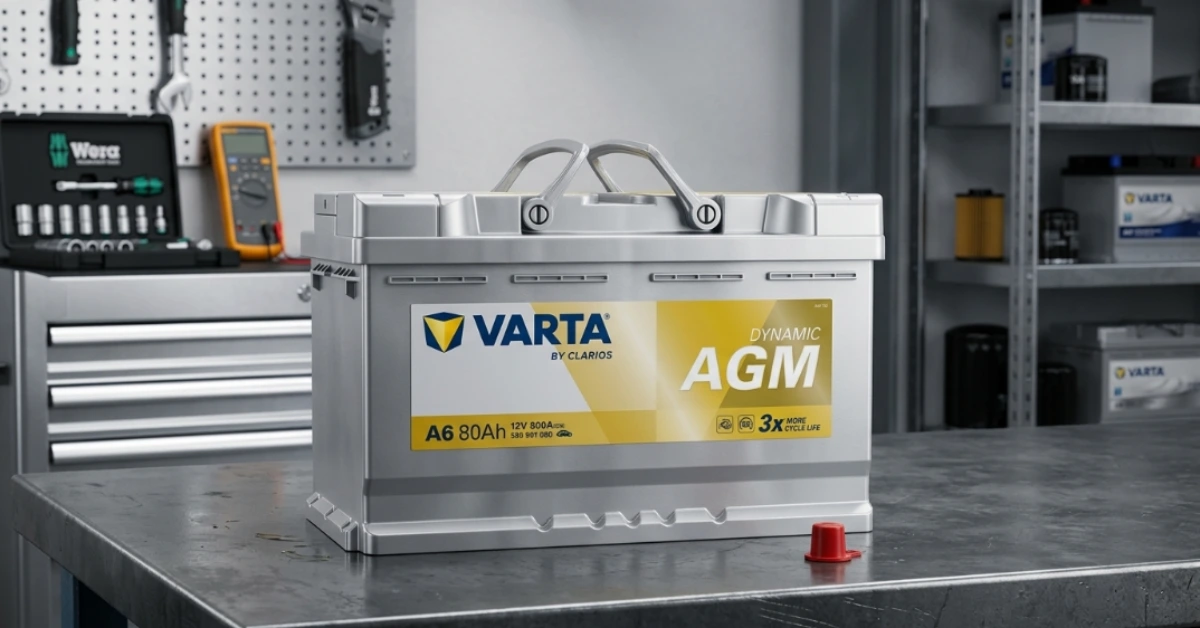
The Varta AGM battery delivers 3x the cycle life of conventional flooded batteries, operates at approximately 2% internal resistance (versus 10 to 15% in flooded batteries), and sustains reliable voltage output in under-bonnet temperatures above 50 degrees C.
Backed by 135 years of German engineering, Varta powers 70% of all new start-stop vehicles worldwide with AGM batteries. This guide covers every technical and practical question UAE drivers have before buying one.
What Is a Varta AGM Battery?
AGM stands for Absorbent Glass Mat. The electrolyte is sulfuric acid mixed with water. This electrolyte is fully contained within a tightly packed glass fiber mat rather than free liquid between the lead plates. This design keeps the battery sealed and stable.
A Varta AGM battery is a valve-regulated lead-acid (VRLA) battery. It is spill-proof, maintenance-free, and supports fast charging and strong power delivery. It handles a higher electrical load compared to standard flooded batteries.
Varta batteries are manufactured by Clarios, the world’s largest automotive battery producer, in Zwickau, Germany. This facility is known for high-precision AGM production used in modern vehicle systems.
These batteries are used in factory-installed systems of BMW, Mercedes-Benz, Audi, Volkswagen, Porsche, Land Rover, and Volvo. These vehicles use advanced electrical systems that require stable and high-performance battery output.
This battery is not a modified version of a normal battery. It is a completely different design built for start-stop systems, regenerative braking, Belt Starter Generators (BSG), and high-electronic-load vehicles with infotainment and safety systems.
How Does a Varta AGM Battery Work?
Absorbent Glass Mat (AGM) Separator Technology
A conventional flooded battery uses a liquid electrolyte that moves freely around the lead plates. This liquid sits between the positive plate (lead oxide) and the negative plate (sponge lead) and reacts during charging and discharging.
An AGM battery uses a different design. The electrolyte is absorbed inside a very fine borosilicate glass fiber mat. This mat has about 93% empty space (porosity) and is tightly pressed between the plates under controlled pressure.
This structure creates 3 clear technical results:
- No free acid movement: Acid stays locked inside the glass mat. This reduces plate corrosion and slows sulfation, especially in high heat conditions.
- Gas recombination system: Oxygen gas formed during charging moves through the mat and reacts at the negative plate to form water again. This makes the battery sealed, safe, and maintenance-free.
- Lower internal resistance: AGM batteries have about 2% internal resistance, while flooded batteries have 10–15%. This allows faster charging and stronger current delivery during engine start.
Valve-Regulated Sealed Design (VRLA)
A Varta AGM battery uses a VRLA (Valve-Regulated Lead-Acid) design. In this system, gases formed during charging and discharging remain inside the battery and are reused rather than escaping into the air.
A small safety valve controls internal pressure (typically set at 10 to 34 kPa). This valve opens only when pressure becomes too high during abnormal overcharge conditions. Normal operation keeps the battery fully sealed and stable.
This sealed design gives 3 important benefits:
- Non-spillable structure: Acid does not leak even if the battery is tilted.
- Flexible installation: Battery fits in trunk, cabin, or under seats.
- Certified safety: Battery meets IATA A67 non-spillable transport standard.
Flooded batteries must remain upright and require a ventilated engine bay.
3. PowerFrame® Patented Grid Technology
The PowerFrame® grid is a Varta-patented stamped-grid system used in both battery plates. A normal battery uses a cast grid. PowerFrame uses a precision-stamping method that strengthens the metal structure and makes it more uniform.
This design improves the flow of electricity within the battery. It also increases strength and life in high heat and heavy load conditions.
Varta testing shows 3 clear improvements compared to cast-grid batteries:
- 60% better electrical flow: Power flows faster and more smoothly through the battery, improving starting power.
- 3x higher corrosion resistance: A stronger grid structure reduces rust inside the battery and extends life.
- 20% lower production energy use: Manufacturing uses less energy and produces fewer emissions than cast-grid batteries.
Cell Compression and Plate Stack Integrity
A Varta AGM battery keeps its internal plates and glass mat separators under controlled pressure. This pressure stays balanced to support stable battery performance. Low pressure causes electrolytes to dehydrate inside cells. High pressure damages the glass mat structure.
Varta uses a strong ABS casing to hold the correct pressure inside the battery. This casing keeps all internal parts stable in different temperature conditions. The battery operates over a wide temperature range from -40°C to +60°C. This helps maintain steady power output during its full life.
Battery Management Sensor (BMS) Compatibility
Modern vehicles such as BMW, Mercedes-Benz, Audi, Volkswagen, and Land Rover use a Battery Management Sensor (BMS) or an Intelligent Battery Sensor (IBS). This sensor is connected to the negative terminal of the battery.
The sensor continuously monitors current, voltage, and temperature. It sends this data to the Energy Management System (EMS). The EMS controls alternator charging and start-stop system operation based on this data.
Varta AGM batteries match the exact electrical behavior that BMS systems require. They follow the correct impedance, charge acceptance, and voltage response patterns.
Installing a non-AGM battery in a BMS-equipped car causes incorrect charging control. This leads to faster battery wear and early failure. After battery replacement, registration using an OBD-II diagnostic tool resets the BMS learning values. This step ensures correct charging and system balance.
Varta AGM Battery Range Available in the UAE
Varta Silver Dynamic AGM: Best for Passenger Cars and SUVs
The Silver Dynamic AGM is the OEM-equivalent replacement for passenger vehicles with start-stop systems, regenerative braking, or significant electronics loads. It is manufactured to the same specification as factory-fitted batteries for BMW, Mercedes-Benz, Audi, and Volkswagen.
Technical specifications:
Nominal voltage: 12V DC
Capacity range: 60Ah to 105Ah (varies by vehicle group size)
CCA (EN) range: 680A to 950A depending on Ah rating
Cycle life: 3x longer than conventional flooded VARTA batteries
Charge acceptance: Significantly higher than EFB or flooded, allowing faster recharge in stop-start traffic
Recommended charging voltage: 14.4V to 14.8V (AGM-specific smart charger required)
Float voltage: 13.6V to 13.8V
Self-discharge rate: Significantly lower than that of flooded batteries, suitable for extended storage periods
Operating temperature range: -40 degrees C to +60 degrees C
Depth of discharge (DoD) tolerance: Up to 80% DoD versus 50% DoD limit for flooded batteries at equivalent cycle life
Compatible vehicles include BMW 3 Series (F30/G20), Mercedes-Benz C-Class (W205/W206), Audi A4 (B8/B9), Range Rover Sport (L461), Volkswagen Tiguan (Mk2), and Porsche Cayenne (9YA), among others.
Varta Dynamic AGM: For Maximum Electrical Demand
The Varta Dynamic AGM battery is designed for vehicles with a very high electrical load. It supports modern systems in which the battery handles engine starting and provides continuous power during engine-off conditions.
These systems include mild hybrid (MHEV) technology, Belt Starter Generator (BSG) setups, and xEV platforms. In these vehicles, the battery supports both cranking and long electrical usage when the engine stops.
This battery delivers strong charge acceptance and stable performance under heavy load conditions.
Best-fit applications include:
- High-performance cars with advanced electronics
- Mild hybrid (MHEV) vehicles with 48V or 12V systems
- Cars with Belt Starter Generator (BSG) systems
- Vehicles requiring a maximum charge acceptance rate
Dynamic AGM maintains stable voltage output even under continuous electrical demand.
Varta Professional AGM: For Leisure and Auxiliary Applications
The Varta Professional AGM battery is designed for deep-cycle use. It supports applications that repeatedly discharge and recharge the battery without losing performance. This battery is used in motorhomes, marine vessels, caravans, and off-road vehicles. It handles both steady power supply and repeated deep discharge conditions.
Unlike cranking-focused batteries, this model is built for energy storage and long-duration load support. It is rated for deep discharge up to 80% Depth of Discharge (DoD) and still recovers normal capacity without major loss.
Best-fit applications include:
- Motorhomes with onboard appliances like lights and refrigerators
- Boats with navigation systems such as chart plotters and VHF radios
- Off-road vehicles with winches and auxiliary lighting systems
- Caravans using inverter-based electrical loads
A professional AGM maintains stable energy output during long, continuous use cycles.
Varta AGM Battery Performance in UAE Conditions
What UAE Heat Does to a Standard Flooded Battery?
The UAE’s climate puts extreme strain on car batteries. Cities like Dubai, Abu Dhabi, and Sharjah regularly reach 42°C to 50°C in summer. When a car is parked in the sun, the engine bay temperature near the battery can reach 60°C to 65°C.
This creates 5 electrochemical failure modes that systematically destroy conventional flooded batteries:
- Electrolyte evaporation (H2O loss): Above 40 degrees C, water evaporates from the electrolyte at an accelerating rate. As the electrolyte concentration increases, internal resistance rises, and plate exposure begins. A flooded battery losing even 10% of its electrolyte volume degrades measurably in capacity and CCA output.
- Accelerated sulfation (PbSO4 crystal growth): Lead sulfate crystals form naturally during discharge. High temperatures accelerate the growth of hard, irreversible sulfate crystals on plate surfaces. Once crystalline sulfation exceeds 30-40% of the active plate area, the battery cannot recover to full capacity.
- Acid stratification: Acid settles to the bottom of the battery. Light acid stays on top. This uneven mix causes both bottom-plate corrosion and top-plate sulfation.
- Grid corrosion acceleration: Positive-plate grids slowly oxidize at elevated temperatures. Every 10°C rise nearly doubles corrosion speed. At 50 °C, corrosion is about 10 times faster than at 20 °C.
- Short service life: Combined damage reduces flooded battery life in the UAE to 12 to 18 months. The same battery lasts 3 to 5 years in cooler climates.
How the Varta AGM Battery Handles UAE Heat Failure Modes?
The Varta AGM battery is designed to address the specific failure issues that occur in the UAE’s hot conditions. It uses sealed construction and glass mat technology to maintain stable internal chemistry even at 50°C+ temperatures.
- No electrolyte evaporation: The borosilicate glass mat holds the electrolyte in place. No free liquid exists, so evaporation does not occur even at high engine bay temperatures. Electrolyte level stays stable throughout the battery life.
- No acid stratification: The electrolyte remains locked inside the glass mat. No liquid movement happens inside the cell. This keeps chemical activity equal across all plates and maintains stable capacity.
- Fast recharge in traffic: Internal resistance stays around 2%, while flooded batteries operate at 10–15%. In Dubai traffic, where driving gaps are only 2–4 minutes, AGM batteries recharge faster and maintain a more balanced charge.
- Higher discharge tolerance: AGM batteries handle up to 80% Depth of Discharge (DoD). Standard flooded batteries handle about 50% DoD. This supports repeated starts, AC load, and short-trip driving, which are common in UAE cities.
- Stronger corrosion resistance: PowerFrame grid technology offers about 3x the corrosion resistance of cast grids. This reduces heat-driven grid damage and improves long-term stability.
Final result for UAE drivers: A Varta AGM battery delivers 3 to 5 years of service life in UAE conditions, while a standard flooded battery typically lasts 12 to 18 months in the same environment.
Varta AGM Battery vs. Standard Flooded Battery
Technical Parameter | Varta AGM Battery | Standard Flooded Battery |
Electrolyte design | Immobilized in borosilicate glass mat (VRLA sealed) | Free liquid sulfuric acid (vented) |
Internal resistance | Approximately 2% | 10% to 15% |
Depth of discharge (DoD) | Up to 80% DoD without cycle loss | 50% DoD limit for equivalent cycle life |
Cycle life vs flooded baseline | 3x longer cycle life | Standard baseline |
Electrolyte evaporation | Zero, fully sealed design | Continuous above 40°C |
Acid stratification | Impossible due to no free liquid | Occurs in all flooded batteries |
Grid corrosion resistance | 3x higher (PowerFrame stamped grid) | Standard cast grid |
Charge acceptance rate | Significantly higher | Lower charge acceptance |
UAE service life | 3 to 5 years | 12 to 18 months |
Start-stop (ISS/MSS) compatibility | Fully compatible, OEM engineered | Not recommended |
BMS/IBS sensor compatibility | Fully compatible, matched impedance | Incompatible, causes EMS errors |
Installation orientation | Any position, IATA A67 certified | Upright only |
Maintenance requirement | None, fully sealed | Periodic electrolyte top-up required |
Operating temperature range | -40°C to +60°C | Narrow range, degrades above 40°C |
Varta AGM vs EFB: Key Differences
EFB (Enhanced Flooded Battery) is a modified version of a standard flooded battery. It uses a Polyvlies scrim layer on the positive plate paste. This layer reduces material shedding and improves cycle stability. EFB batteries deliver about 2x the cycle life of standard flooded batteries. They are mainly used in entry-level start-stop systems that restart the engine after clutch release (Type A ISS).
Varta AGM performs better than EFB in several technical areas that matter in UAE driving conditions.
- Charge acceptance: AGM absorbs charge faster. This is important in vehicles with regenerative braking, where high current is generated during deceleration.
- Depth of discharge (DoD): AGM batteries can handle up to 80% DoD. EFB handles around 60% DoD before the cycle life drops.
- Temperature stability: AGM uses a sealed, immobilized electrolyte. EFB uses a free liquid electrolyte, which performs less effectively in the UAE’s high heat above 40°C.
- System compatibility: AGM is required for advanced systems like Type B start-stop, xEV hybrids, and Belt Starter Generator (BSG) platforms. EFB cannot reliably support these systems.
- Critical rule: Vehicles calibrated for AGM use specific charging voltages and algorithms in their Energy Management System (EMS). Installing EFB in such systems causes overcharging and early failure. Downgrading from AGM to EFB is not safe. Upgrading from EFB to AGM remains safe and improves reliability.
Who Needs a Varta AGM Battery in the UAE?
A Varta AGM battery is required for vehicles with advanced electrical systems that demand stable power, fast charging, and heat resistance. UAE driving conditions increase battery load, making the correct selection critical for reliability.
You need a Varta AGM battery if your vehicle has any of the following systems:
- Start-stop (ISS/MSS) system: The engine stops at signals and restarts when the driver presses the clutch or brake. Vehicles with ISS always require AGM or EFB. If the AGM is originally installed, the replacement must also be an AGM.
- Battery Management Sensor (BMS/IBS): A sensor on the negative terminal monitors voltage, current, and temperature. It works with Smart Charging Systems. Models like BMW F-series and G-series, Mercedes W205 and W213, Audi B8 and B9, Volkswagen MQB, and Land Rover L460 and L461 use this system.
- Belt Starter Generator (BSG) or 48V mild hybrid (MHEV): These systems use regenerative braking to charge the 12V battery. An AGM is required because it handles high, fast charge pulses. Standard batteries fail quickly in these setups.
- High electrical load vehicles: Systems like ADAS cameras, radar units, and LiDAR sensors use 15–40 watts continuously. Heated seats use 80–120 watts per seat. Air suspension, sunroof motors, and adaptive headlights add extra load. AGM supports this continuous demand with stable output.
- Frequent early battery failure in the UAE: If a battery fails every 12–18 months, heat stress is already above design limits. AGM batteries directly address the 5 main causes of failure in the UAE, including heat, sulfation, and rapid discharge cycles.
4 Key Specifications to Check When Buying a Varta AGM Battery
1. Capacity (Ah, Amp Hours)
Ah shows how much charge a battery stores and delivers in 20 hours (C20 rating). It defines total energy capacity in real vehicle use. Never select a lower Ah rating than the OEM specification, as modern cars depend on accurate battery capacity for stable operation.
The Vehicle Energy Management System (EMS) uses the rated Ah value to set charging control. A lower Ah battery forces the EMS to push a higher charge load for the same system demand. This condition increases internal wear and reduces battery service life.
2. CCA (Cold Cranking Amps, EN Standard)
CCA EN measures the starting current output for 10 seconds at -18°C while the voltage remains above 7.5V. It defines how strong the battery performs during engine ignition. UAE heat does not diminish the importance of CCA, as engine cranking still requires a high burst current.
Engine oil viscosity increases when the ambient temperature exceeds 45°C during heat-soaking. Starter motor load rises in this condition and requires 200 to 600 amps, depending on engine size. A battery reduced to 70% of its rated CCA often fails during peak summer starts above 47°C.
3. Physical Group Size and Terminal Orientation
Varta uses a DIN size system from LN1 to LN6 for most European and Asian vehicles. Some vehicles use BCI group sizing depending on the manufacturer’s design. The battery must match the tray size exactly for a secure fit and stable electrical contact.
Terminal orientation defines positive and negative placement on the battery casing. Incorrect polarity alignment causes installation failure and the risk of a short circuit to the vehicle body. Proper fit ensures stable mounting and safe current flow during vibration and load.
4. ETN Code (European Type Number)
Every Varta battery carries a 12-digit ETN code that defines full technical identity. It includes DIN size, voltage level, Ah capacity, CCA rating, and terminal layout configuration. This code ensures exact OEM-level replacement matching.
Example ETN 580901080 represents an 80Ah capacity and 800A CCA output. Terminal layout code 0 indicates a positive terminal on the right side. Matching the ETN code guarantees a correct fitment and avoids an electrical mismatch in EMS-controlled vehicles.
Is a Varta AGM Battery Worth the Extra Cost?
5-Year Cost Analysis: UAE Conditions
Cost Factor | Standard Flooded Battery | Varta AGM Battery |
Average UAE service life | 12 to 18 months | 3 to 5 years |
Replacements needed over 5 years | 3 to 4 batteries | 1 battery |
Installation cost per replacement | Paid 3 to 4 times | Paid once |
BMS registration cost per replacement | Paid 3 to 4 times (if applicable) | Paid once |
Risk of being stranded in 47°C heat | Every 12 to 18 months | Every 3 to 5 years |
Risk of EMS fault codes from wrong battery | High | None |
Total 5-year ownership cost | 2 to 4× battery purchase price | Single investment |
Beyond direct cost, fitting an incorrect or undersized battery in a modern vehicle with an active EMS triggers U0115 (Lost Communication with ECM/PCM ‘A’) and B1080 (Battery Management System) fault codes. Diagnosing and clearing these fault codes at a dealership or specialist workshop costs between AED 300 and AED 800 per visit in the UAE, a cost that is entirely avoided by fitting a correctly specified Varta AGM from the start.
How to Charge and Maintain a Varta AGM Battery?
A Varta AGM battery performs best when charging and maintenance are performed within the correct technical limits. UAE heat, short trips, and long parking periods all affect battery charge balance and life. Correct charging prevents sulfation, overcharge stress, and early failure.
Use an AGM-Specific Smart Charger
A standard charger without AGM mode applies incorrect voltage levels, which can damage battery chemistry over time. It either keeps the battery undercharged at 80% to 90% State of Charge (SoC) or overcharges above 14.8V, which stresses the oxygen recombination system inside the VRLA battery.
Use a multi-stage smart charger with AGM mode. Recommended charging current is 8A to 12A (around 10% of Ah rating). Charging stages include bulk charge, absorption at 14.4V to 14.8V, and float at 13.6V to 13.8V.
Avoid Deep Discharge Below 10.5V
AGM batteries support a deep discharge of up to 80% Depth of Discharge (DoD), but going below 10.5V terminal voltage can cause permanent sulfation in lead-acid chemistry.
If a vehicle is not used for more than 14 days, connect a maintenance charger. Chargers like CTEK MXS 5.0 (AGM-rated) help maintain stable voltage during storage periods.
Manage Short-Trip Driving Patterns
Short trips under 10 km do not allow full alternator recharge time. In the UAE, frequent stops increase energy consumption while reducing recharge recovery time.
This creates a repeated discharge cycle inside the battery. A monthly top-up charge at 14.4V absorption voltage restores full charge balance and prevents long-term capacity loss.
Inspect Terminals Every 3 Months
Humidity in coastal cities like Dubai, Sharjah, and Abu Dhabi can cause terminal oxidation. This appears as white or blue-green deposits of lead sulfate and copper sulfate.
Clean terminals every 3 months using a sodium bicarbonate solution and a brass brush. Apply dielectric grease after cleaning to prevent corrosion reformation and maintain stable current flow.
Register The Battery After Installation
Modern vehicles use systems like BMW IBS, Mercedes BEM (Battery Energy Management), Audi/VW EMS, and Land Rover IVD (Intelligent Vehicle Dynamics).
These systems require OBD-II battery registration after replacement. Without registration, the EMS uses outdated battery parameters, reducing new battery life by up to 30% due to an incorrect charging strategy.
Seasonal Battery Performance Through the UAE Calendar
The UAE weather varies significantly throughout the year. Temperature, driving load, and parking time all affect battery life. Varta AGM batteries perform more stably across seasons due to their sealed VRLA design and low internal resistance.
- Summer (June to September): Summer is the hardest season for car batteries in the UAE. Outside temperature reaches 42°C to 50°C. Under the bonnet, the heat rises to 60°C-65°C. At the same time, cars run AC, headlights, and ADAS systems together.
Flooded batteries in their second year often fail in this heat. Varta AGM handles this better due to 2% internal resistance and PowerFrame corrosion-resistant grid. It also keeps a stable power flow in high temperatures. - Winter (November to February): Winter is mild in the UAE. The temperature stays around 14°C to 20°C at night. This is safe for all battery types and reduces heat stress.
But weak batteries from summer show low CCA (Cold Cranking Amps) in morning starts. The engine needs slightly more starting power in cooler conditions, so weak batteries fail first. - Spring Transition (March to April): Spring temperatures rise quickly from 20°C to 38°C over about 6 weeks. This fast change puts stress on old batteries. March is a good time for battery testing. It helps find weak batteries before the summer heat starts. Early check reduces breakdown risk.
Frequently Asked Questions
No. The vehicle Energy Management System (EMS) is designed for AGM battery impedance and charge acceptance. A flooded or EFB battery cannot be charged to this profile. The system applies voltage levels that overload the battery and reduce its stability.
This mismatch causes overcharge, grid corrosion, and early failure within 3 to 6 months. AGM specification must always match AGM replacement for correct performance and safety.
A start-stop system turns the engine off when the car stops at traffic signals and restarts it when you press the clutch or release the brake. Vehicles from 2012 onward commonly include ISS (Idle Start Stop) or MSS (Micro Hybrid Start Stop) systems.
A Battery Management Sensor (BMS) or Intelligent Battery Sensor (IBS) attached to the negative terminal confirms smart charging control. Dashboard symbols like “A OFF” or a dedicated start-stop button also indicate this system.
Yes. Upgrading from EFB to AGM is fully safe and technically compatible. AGM delivers higher charge acceptance, deeper discharge stability, and better heat resistance in UAE conditions.
This upgrade improves reliability in vehicles with heavy electronics loads or frequent short-trip driving. Many drivers switch to AGM after repeated EFB battery failures in hot climates.
A Varta AGM battery lasts 3 to 5 years in UAE conditions when correctly installed and matched to the vehicle's specifications. Proper Ah rating, correct CCA selection, and BMS registration improve lifespan stability.
Standard flooded batteries in the same environment typically last 12 to 18 months due to heat stress and electrolyte loss. AGM maintains stable performance even in temperatures above 45°C.
No routine maintenance is required because AGM uses a sealed VRLA design. The electrolyte stays locked inside glass mat separators, so no water top-up or acid check is needed.
Keep terminals clean and free of corrosion to ensure stable current flow. Avoid deep discharge below 10.5V and use a maintenance charger during storage longer than 14 days.
A smart multi-stage charger with AGM mode is required for correct charging. The charging process follows three stages: bulk charge at constant current, absorption at 14.4V to 14.8V, and float at 13.6V to 13.8V.
Standard chargers without AGM control damage battery chemistry over time. Incorrect charging leads to undercharge or overcharge, both of which reduce service life.
Yes. Battery registration is required for vehicles with EMS, BMS, or IBS systems. These systems include BMW F and G series, Mercedes W205, W213, W223, Audi B8 to B10, VW MQB platform, and Land Rover modern models.
Registration is performed through an OBD-II diagnostic tool. It resets battery adaptation values so the system correctly manages charging for the new AGM battery.